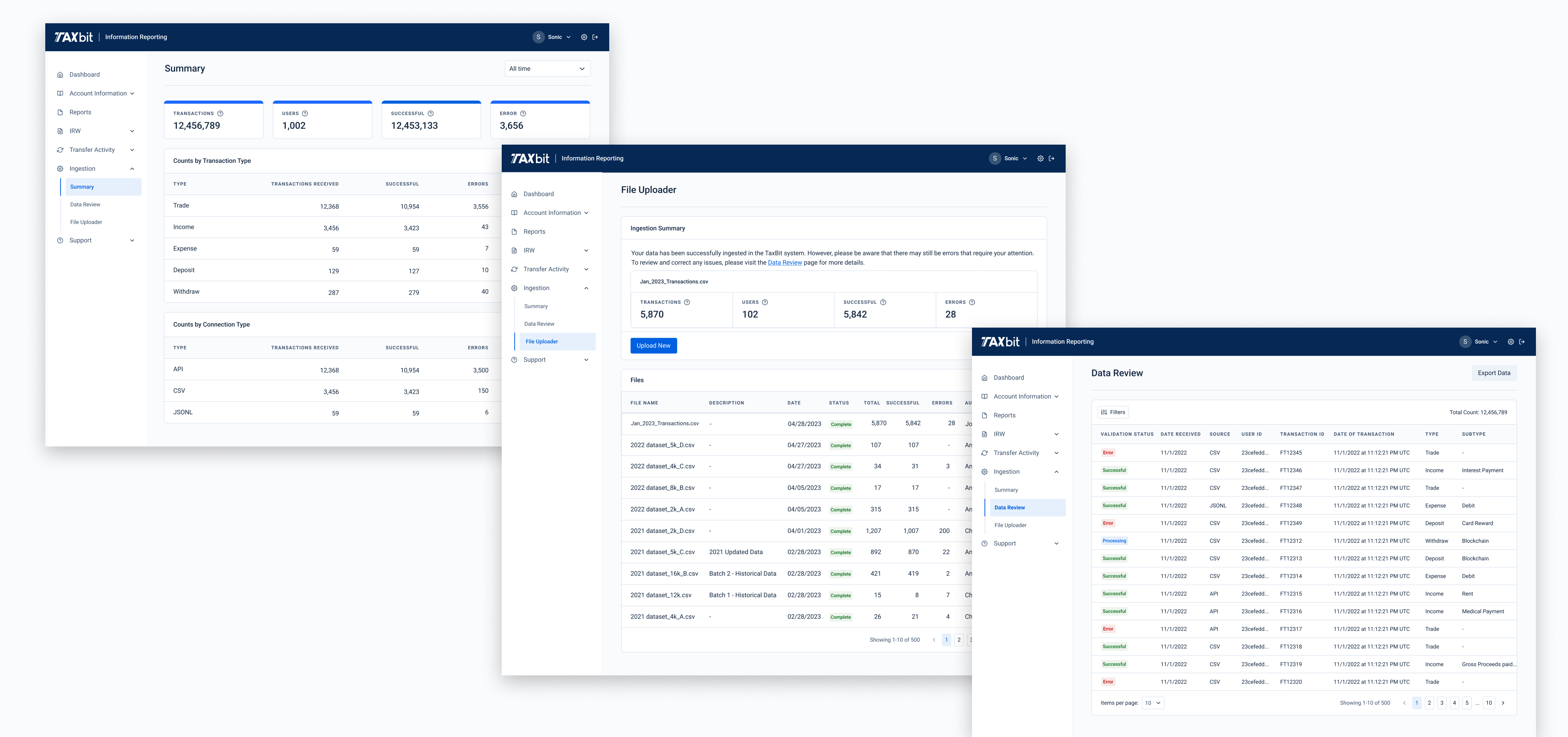
Enterprise onboarding at scale.
Enterprise clients onboarding into TaxBit often needed to upload millions of rows of crypto transaction data across multiple wallets, exchanges, and accounting systems. The upload process was technically functional, but operationally extremely painful.
Before the redesign:
- Customers relied heavily on customer service teams
- Integrations required extensive manual coordination
- Onboarding involved constant email and message follow-ups
- File formatting errors were often discovered too late in the process
In many cases, uploads took multiple days to process before users learned the entire dataset contained invalid formatting or schema issues.
The operational overhead affected both enterprise clients and internal TaxBit support and integration teams.
The upload wasn’t the problem — coordination was.
The biggest challenge wasn’t simply uploading files. It was reducing the coordination friction surrounding the upload process itself.
Enterprise onboarding frequently involved:
- Repeated email exchanges
- Unclear formatting requirements
- Delayed error discovery
- Difficult cross-team communication
- Stalled onboarding timelines
One of the most painful issues occurred when large uploads failed after several days of processing because of incorrect headers, invalid formatting, and schema mismatches.
By the time errors were discovered customers were frustrated, support teams were overloaded, and onboarding momentum was lost.
The system technically provided downloadable templates, but users still became overwhelmed when dealing with massive datasets and unclear validation feedback.
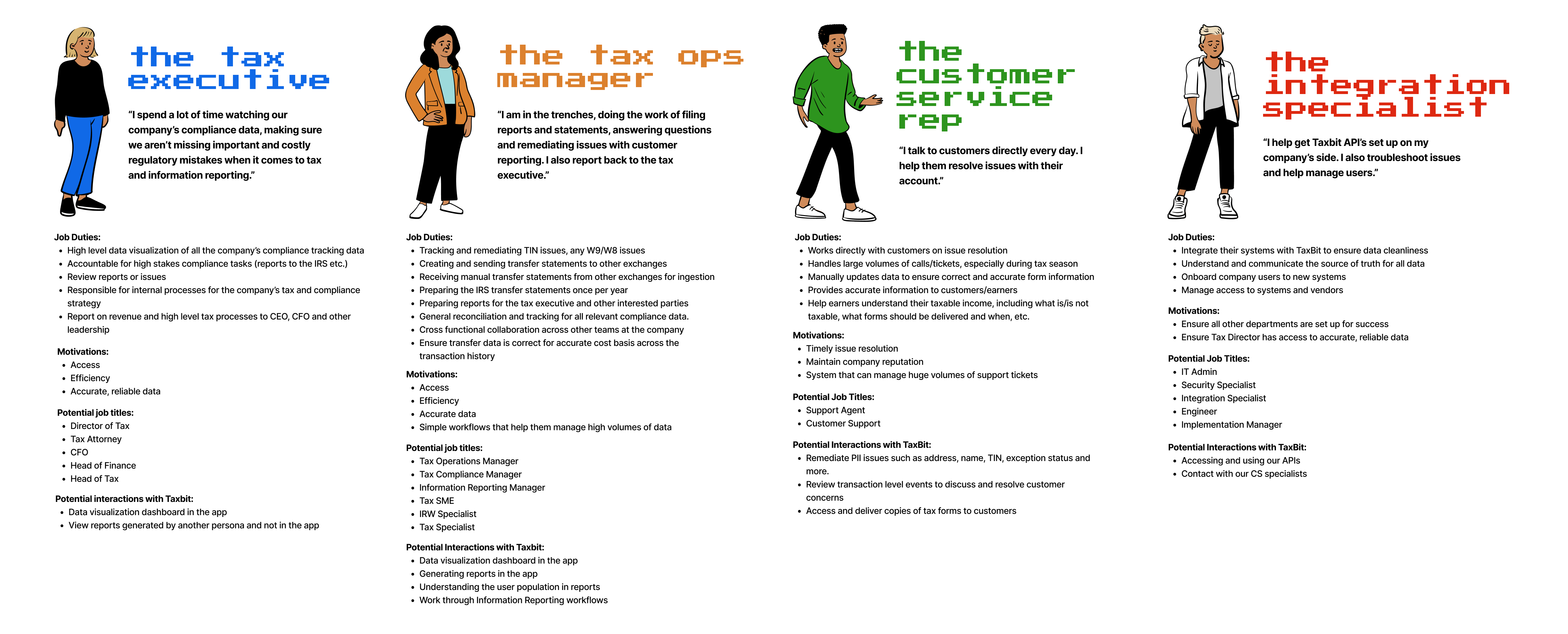
Four personas, one workflow.
One of the core UX challenges was designing a workflow flexible enough to support four distinct enterprise personas with very different operational priorities.
Tax Executive
Focused on onboarding visibility, operational confidence, and minimizing delays.
Tax Ops Manager
Needed workflow oversight, upload monitoring, and coordination visibility across teams.
Customer Service Representative
Required faster issue detection and reduced manual back-and-forth communication with clients.
Integration Specialist
Needed precise validation feedback early in the upload process to prevent downstream processing failures.
Rather than optimizing for a single user, the challenge became designing a system that balanced operational clarity, technical accuracy, and workflow efficiency across the entire onboarding ecosystem.
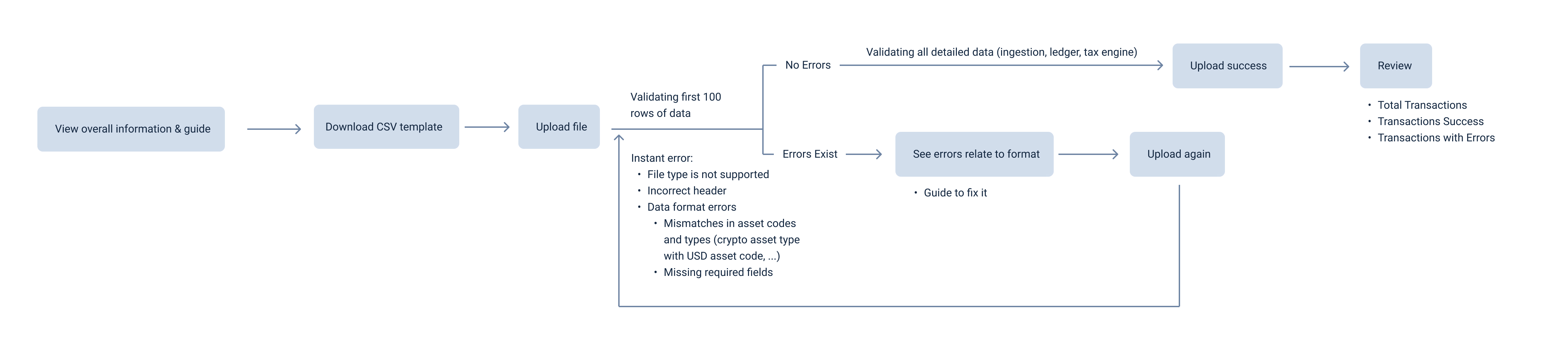
Validate early, not days later.
Through conversations with customer service representatives and integration specialists, one insight became immediately clear:
Early validation mattered more than post-processing correction.
The largest operational pain came from discovering critical formatting issues too late in the process.
To address this, the team introduced a new validation approach:
- Validate the first 100 rows immediately after upload
- Surface critical formatting and schema issues early
- Prevent multi-day processing failures before they happen
This shifted the workflow from: ❌ upload → wait → fail to ✅ validate early → correct quickly → process confidently.
The uploader became less of a file transfer tool and more of a guided onboarding workflow.
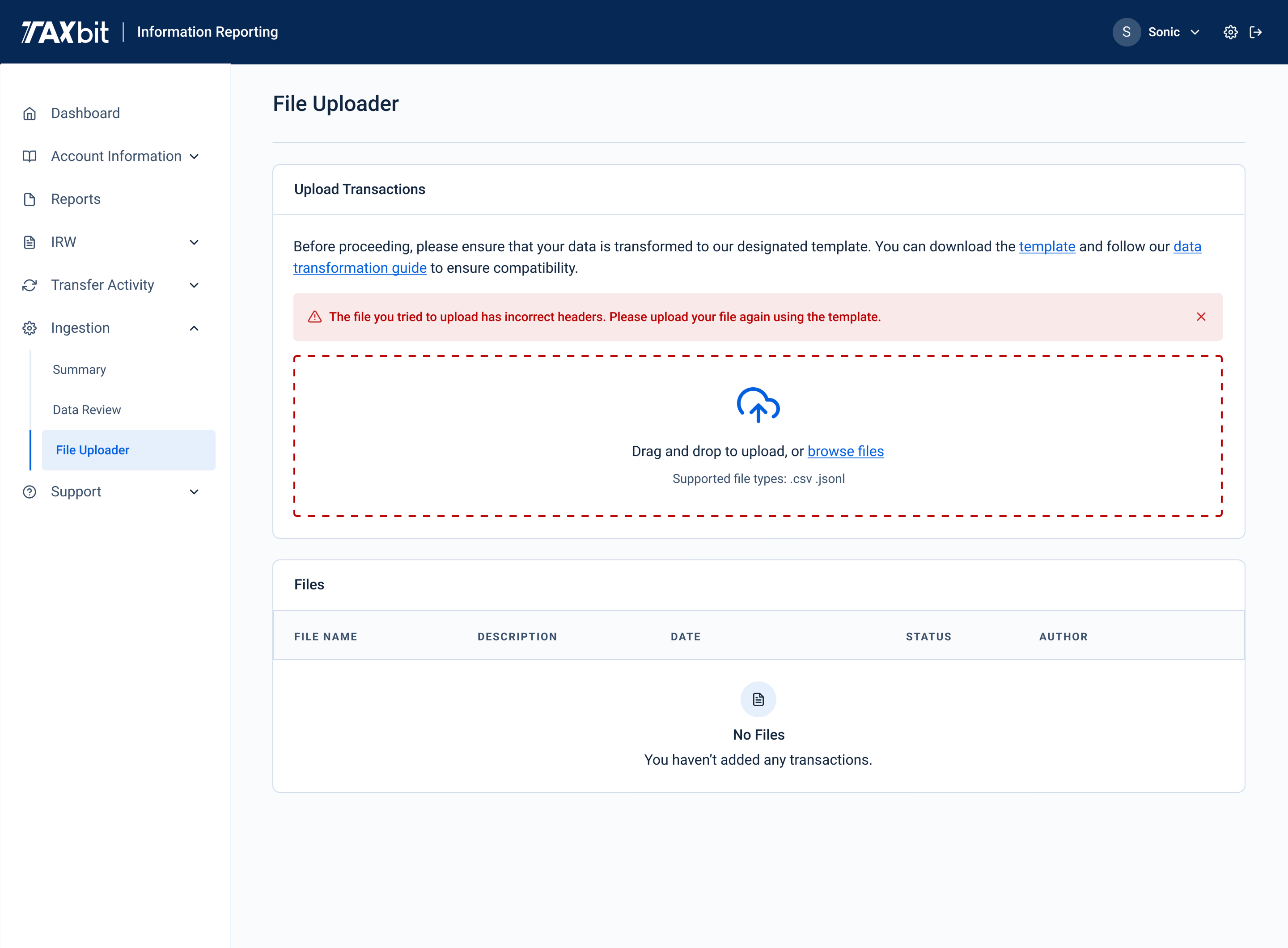
Reducing overwhelm through guided validation.
The UX focused heavily on reducing overwhelm during large-scale enterprise uploads.
I designed the experience around:
- Progressive validation
- Clearer system feedback
- Actionable error states
- Guided correction workflows
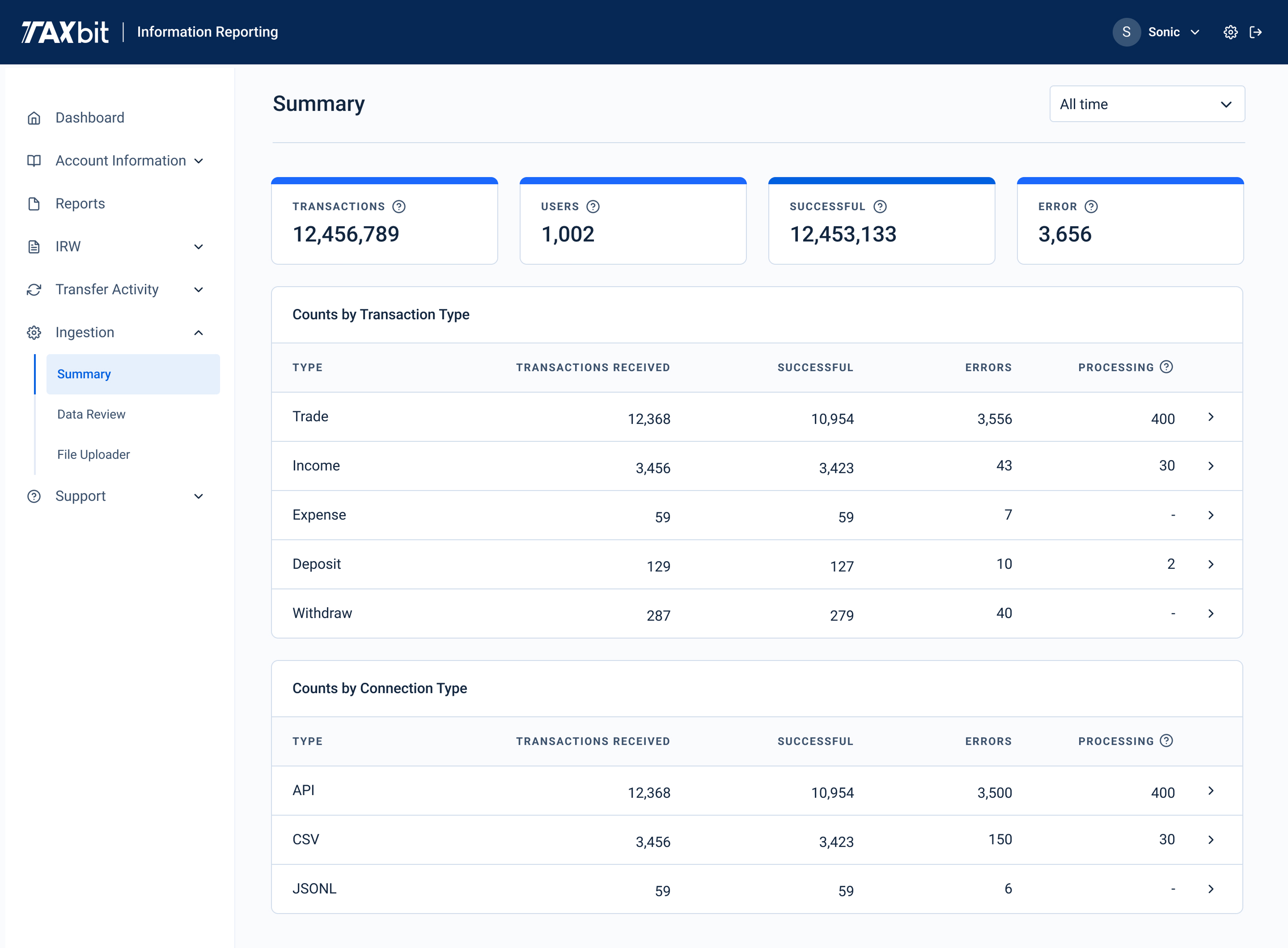
The uploader surfaced:
- Validation progress
- Formatting issues
- Incorrect headers
- Required corrections
- Upload readiness states
Instead of exposing users to large volumes of raw technical errors, the experience prioritized clarity, prioritization, and operational confidence.
The goal was to help users resolve problems as early and as quickly as possible before entering long-running processing flows.
This significantly reduced the amount of manual coordination previously required between clients, customer service teams, and integration specialists.
Faster onboarding, fewer failures.
Increase in task completion rate
Row early validation system introduced
Personas unified onboarding workflow supported
Takeaways
- Learned how operational friction often exists outside the interface itself — especially in enterprise onboarding and cross-team coordination workflows.
- Reinforced the importance of validating critical errors as early as possible inside large-scale data processing systems.
- Strengthened my ability to design workflows balancing technical complexity, operational clarity, and multiple stakeholder needs simultaneously.